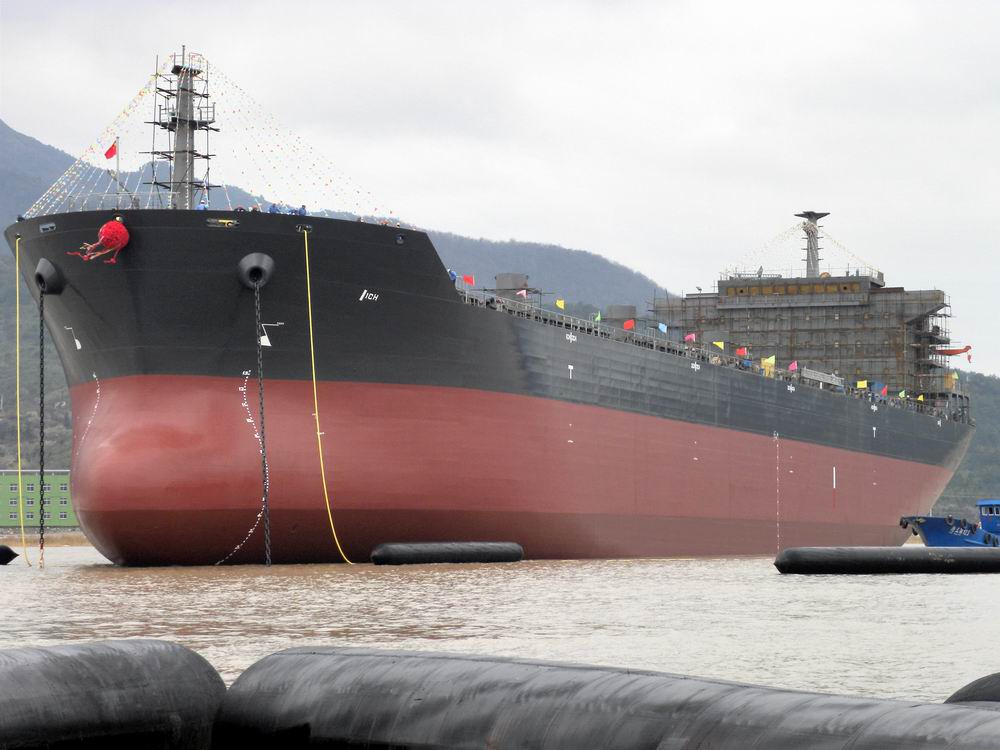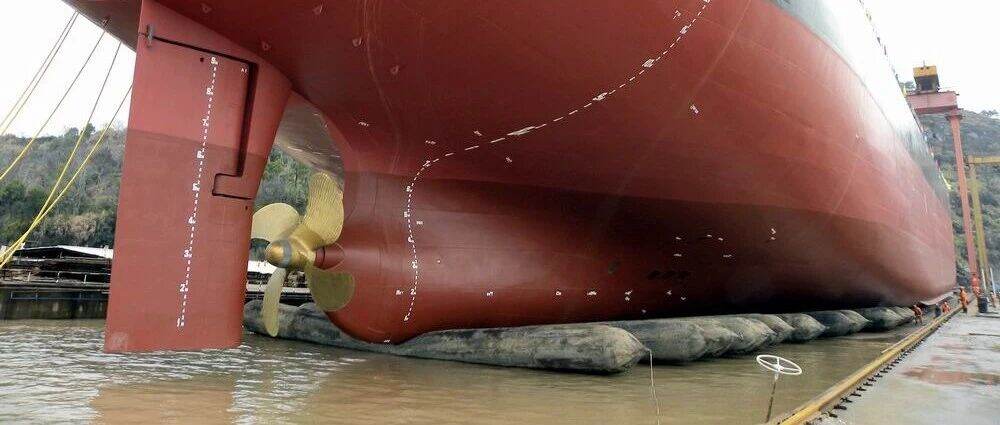
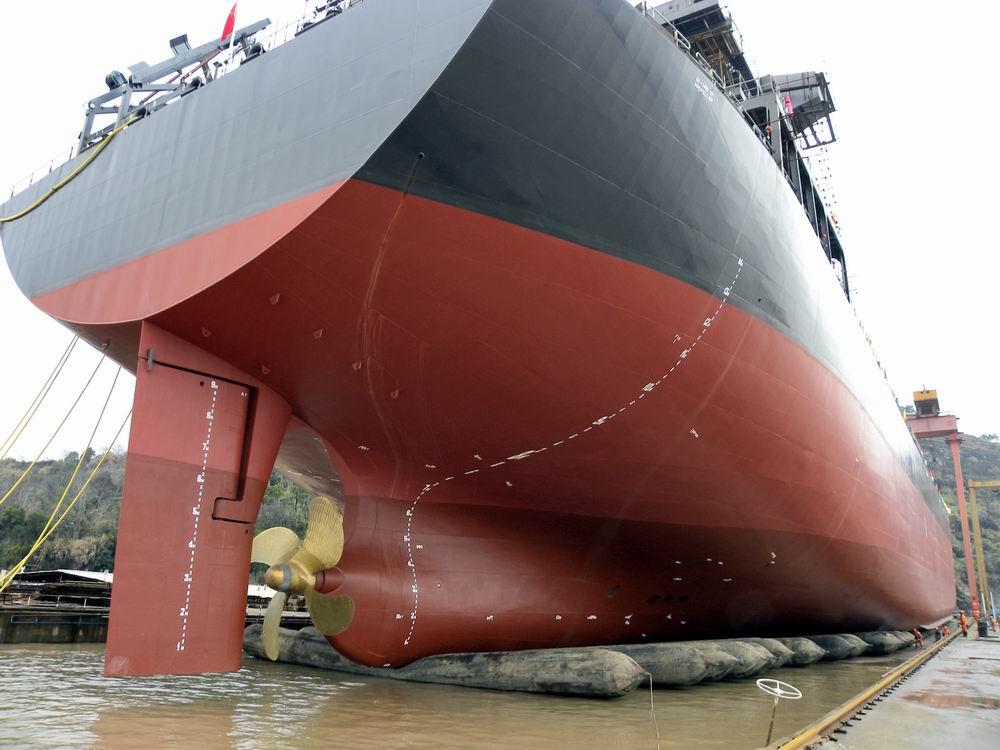
This cargo ship holds 11,800 tons is 199 meters long and 32 meter wide. It is built on a 0.87 degree concrete ramp whose end is a sluice gate. From the water gate to ship’s stern is 15 meters and the water beyond the gate is 8 meters deep. Total 76 pieces YT-6 type Evergreen Marine airbags are employed to complete this project and also two 25 tons winches.
For big ship launched with marine airbags, the scientific design from calculation is vital for success. To ensure this DWT58, 000 cargo ship’s safe launching, there are two conditions must be satisfied first: avoiding the “bow decline” during the launch process and the rush distance is controllable when ship is after launch.
Qingdao Evergreen Maritime engineers are gathered to calculate the launching project of the largest ship ever be launched by Evergreen Marine Airbags. From mathematic modeling to computer simulation every step of launching process are researched carefully. From the water level to weather variety most conditions are considered for the design. When settle the arrangement of Airbags, Evesafe engineers find the stern rope must be added to control the rush of ship after launch. So 4 stern ropes are demanded to fix on the bollard of a floating dock with 45 degree angle to the ship and the time of cast anchor is also stated.
At 31 Jan. Qingdao Evergreen Maritime team completed the ship raise and most block remove work. At that time two winched pulled ship from slipping and the blocks under stern remained. The highest tide of 1 Feb. is estimated to occur at 10:30 AM, so launch time is decided to be 10 AM. At 9:30 am Evergreen-Maritime team began to adjust the inner pressure of ship launching airbags at stern to be 0.12Mpa and then released the steel ropes from winches. At 9:50 Marine Airbags under gravity center and bow were inflated to be 0.15Mpa then the ship began to move slowly by riding rolling airbags. During the launch process the ship’s incline angle is increasing until the stern floated when the bow enters into deep water already. There is no “bow decline” phenomena occurred just as forecasted by calculation.